
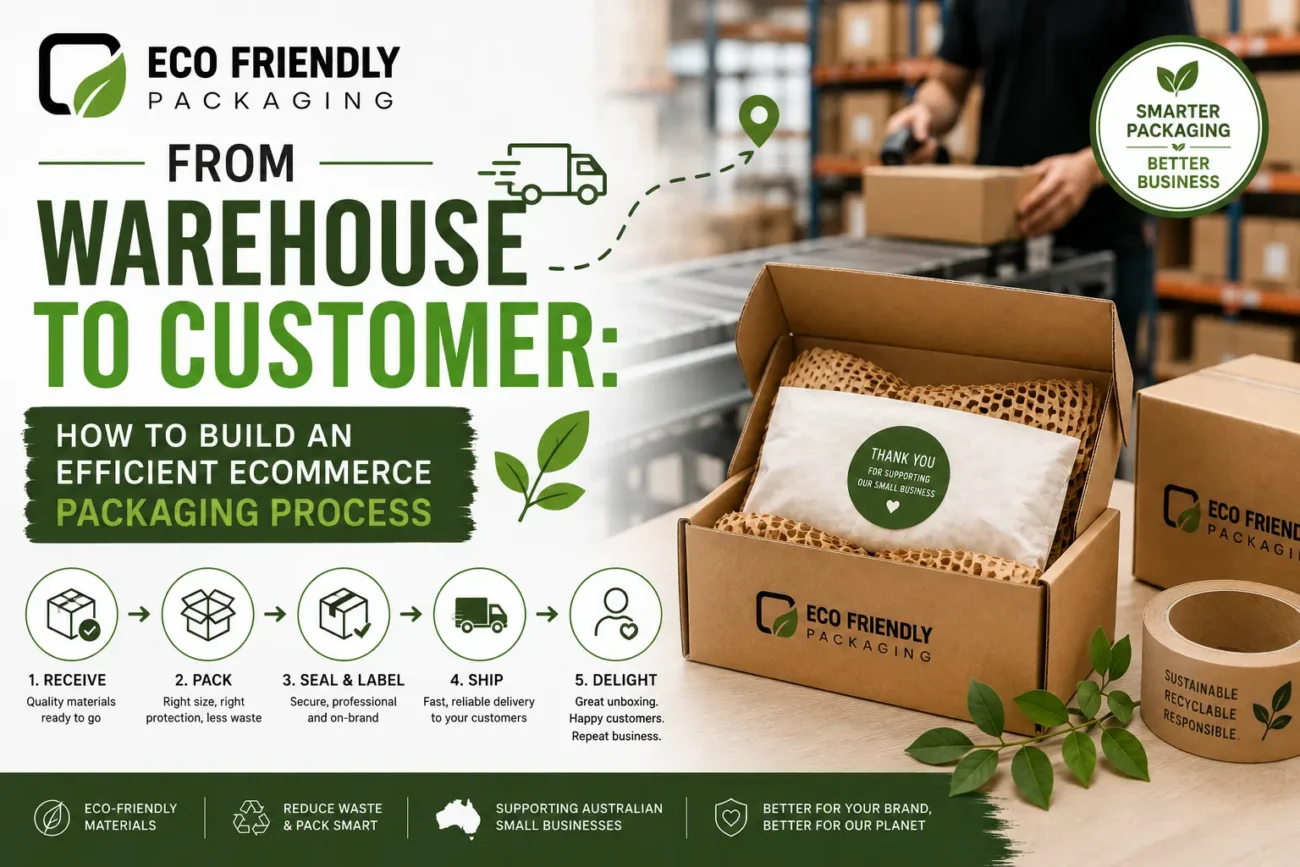
Running an ecommerce business involves much more than getting products listed online and waiting for orders. Once an order is placed, your team needs to pick the right products, select suitable packaging, pack the order safely, label it correctly and prepare it for delivery.
When order volumes are small, this process may seem simple. But as an ecommerce business grows, an inefficient packaging process can quickly lead to wasted time, unnecessary packaging costs, product damage, inventory problems and delayed shipments.
A well-organised ecommerce packaging process helps businesses create a smoother journey from warehouse shelf to customer’s doorstep.
The goal isn’t simply to pack orders faster. An efficient process should balance speed, product protection, packaging costs, sustainability and customer experience.
At Ecofriendly Packaging, we provide packaging solutions for Australian businesses, including cardboard boxes, mailing boxes, mailers, bubble mailers, card mailers, honeycomb mailers, shopping bags, labels, mailing tubes and custom packaging options.
In this guide, we’ll explain how to build a more organised ecommerce packaging process from the moment an order enters your system to the moment it leaves your warehouse.
What Is an Ecommerce Packaging Process?
An ecommerce packaging process is the series of steps a business follows to prepare an online order for delivery.
A typical process includes:
- Receiving the customer order
- Picking the products
- Checking the order
- Selecting appropriate packaging
- Packing and protecting the products
- Sealing the package
- Adding the shipping label
- Conducting a final quality check
- Sorting the package for collection
- Tracking the shipment
While these steps appear straightforward, small inefficiencies can become significant when hundreds or thousands of orders are processed.
For example, if employees spend several minutes searching for packaging for every order, the time adds up quickly.
The solution is to create a repeatable packaging workflow.
Why Ecommerce Businesses Need an Efficient Packaging Workflow
An organised packaging process can help businesses improve several areas of their operation.
Faster Order Fulfilment
When packaging materials and workstations are organised, employees can spend less time searching for supplies.
Lower Packaging Costs
Using appropriately sized packaging can reduce unnecessary material usage and potentially lower shipping-related costs.
Fewer Packing Errors
A standardised process can reduce mistakes such as incorrect products, missing items or incorrect labels.
Better Product Protection
Choosing packaging based on product requirements helps reduce the risk of damage during transportation.
Less Packaging Waste
Right-sized packaging can reduce unnecessary cardboard, paper and protective materials.
Better Customer Experience
Customers expect orders to arrive correctly packed, undamaged and on time.
Step 1: Understand Your Order Types
Before creating your packaging process, analyse the types of orders your business receives.
Look at:
- Most frequently ordered products
- Average order size
- Product dimensions
- Product weight
- Fragile products
- Multi-product orders
- Large orders
- Small orders
- Gift orders
- Frequently bundled products
This information can help you determine which packaging products you actually need.
For example, if most of your orders contain one small product, having several large boxes available may not be necessary.
On the other hand, if customers frequently purchase multiple products together, your business will need larger packaging options.
Step 2: Create Packaging Categories
Instead of asking employees to choose from dozens of packaging products, create simple packaging categories.
For example:
| Order Type | Suitable Packaging | Main Purpose |
| Small & lightweight | Small mailer or mailing box | Fast and compact fulfilment |
| Clothing | Mailer or mailing box | Lightweight product protection |
| Multiple products | Cardboard box | Combine products efficiently |
| Fragile products | Protective cardboard packaging | Reduce damage risk |
| Flat products | Card mailer | Keep items flat and protected |
| Premium orders | Custom packaging | Improve presentation |
| Large orders | Larger cardboard boxes | Accommodate multiple products |
This makes the packaging decision easier for your team.
You can also create simple internal guidelines such as:
1–2 small products → Small mailing box
Several products → Medium cardboard box
Fragile product → Protective packaging
The exact system should be based on your products and order patterns.
Step 3: Organise Your Packaging Station
Your packaging workstation can have a major impact on fulfilment speed.
Employees shouldn’t need to walk across the warehouse every time they need a box, label or piece of tape.
Keep frequently used packaging supplies close to the packing area.
A basic workstation may include:
- Frequently used mailing boxes
- Cardboard boxes
- Mailers
- Labels
- Stickers
- Tape
- Scissors or cutting tools
- Protective materials
- Shipping labels
- Order documents
Keep the most frequently used items within easy reach.
Less frequently used packaging can be stored elsewhere.
The goal is to reduce unnecessary movement during the packing process.
Step 4: Store Packaging by Size
Organising packaging by size can make the warehouse easier to navigate.
For example:
Small
- Small mailers
- Small mailing boxes
- Small labels
Medium
- Medium mailing boxes
- Medium mailers
- Medium cardboard boxes
Large
- Large cardboard boxes
- Larger protective packaging
Clearly identifying packaging sizes can help employees quickly find what they need.
It can also make stock counting easier.
Step 5: Keep Packaging Inventory Under Control
Running out of your most frequently used packaging can disrupt your entire fulfilment operation.
At the same time, ordering excessive quantities can tie up money and storage space.
Create minimum stock levels for your most important packaging products.
For example:
| Packaging Item | Usage | Stock Action |
| Small mailing boxes | High | Reorder frequently |
| Medium cardboard boxes | High | Maintain higher stock |
| Large boxes | Medium | Monitor weekly |
| Custom stickers | Medium | Reorder before minimum level |
| Special packaging | Low | Keep limited stock |
| Shipping labels | High | Maintain backup stock |
The exact quantities depend on your order volume.
The important thing is to know when you need to reorder.
Step 6: Choose the Right Packaging Size
too large.
An oversized box can require:
- More cardboard
- More protective material
- More storage space
- More packing time
- More shipping volume
Right-sized packaging can help create a more efficient fulfilment process.
Ecofriendly Packaging offers mailing boxes and cardboard boxes in different sizes, allowing businesses to choose packaging based on product dimensions and order requirements.
For Australian businesses, selecting suitable mailing boxes Australia customers can receive efficiently can also help create a consistent shipping process.
However, don’t choose the smallest possible package simply to reduce size.
There must still be enough room to protect the product.
Step 7: Match Packaging to Product Protection Requirements
Not every product needs the same level of protection.
A T-shirt doesn’t have the same packaging requirements as a glass bottle or fragile electronic item.
Create packaging guidelines based on product sensitivity.
Low-Risk Products
Products that are lightweight and unlikely to break may require simple mailers or mailing boxes.
Medium-Risk Products
Products that can be scratched, bent or damaged may need additional protection.
Fragile Products
Fragile items may require stronger boxes and appropriate protective materials.
The objective is to use enough protection without unnecessary packaging.
Overpacking wastes materials, while underpacking can result in damaged products.
Step 8: Create a Standard Packing Sequence
A standard packing sequence helps employees complete orders consistently.
For example:
1. Verify the Order
Check the customer’s order against the products picked from inventory.
2. Select Packaging
Choose the appropriate box, mailer or other packaging based on your packaging guidelines.
3. Prepare the Package
Open the box or mailer and prepare any required protective material.
4. Place the Product Inside
Position the products carefully.
5. Add Necessary Protection
Use appropriate protective materials if required.
6. Close and Seal
Secure the package properly.
7. Apply the Shipping Label
Place the shipping label where it can be easily scanned.
8. Final Check
Verify the order, address and package condition.
9. Move to Dispatch
Place the completed package in the appropriate collection or dispatch area.
A standard sequence reduces guesswork and makes employee training easier.
Step 9: Use Clear Packaging Guidelines
If different employees pack orders differently, mistakes can happen.
Create simple packaging guidelines that answer questions such as:
- Which box should be used?
- Which mailer is suitable?
- When is additional protection needed?
- Where should labels be placed?
- Which products need special handling?
- How should multi-product orders be packed?
You can create a simple internal packaging chart and place it near the packing station.
This is especially useful when new employees join your warehouse team.
Step 10: Make Shipping Labels Part of the Workflow
Incorrect or poorly positioned shipping labels can create delivery problems.
Make label application one of the standard final steps in your packaging process.
Before dispatch, verify:
- Customer name
- Delivery address
- Order number
- Shipping method
- Tracking information
- Label readability
The label should be securely attached and positioned so that it can be scanned easily.
A final label check can prevent avoidable shipping errors.
Step 11: Create a Final Quality Check
Before an order leaves the warehouse, conduct a quick quality check.
The check can include:
| Check | Question |
| Product | Is the correct product inside? |
| Quantity | Is the order complete? |
| Packaging | Is the packaging suitable? |
| Protection | Is the product adequately protected? |
| Seal | Is the package securely closed? |
| Label | Is the shipping label correct and readable? |
| Appearance | Is the package clean and presentable? |
A quick final check can prevent mistakes from reaching customers.
Step 12: Reduce Unnecessary Packaging Materials
Efficiency isn’t only about speed.
It’s also about using packaging materials responsibly.
Review whether your business actually needs every packaging component currently being used.
For example:
- Are you using excessive void fill?
- Are boxes significantly larger than products?
- Are multiple layers of packaging necessary?
- Can paper-based alternatives replace unnecessary plastic?
- Can a mailer replace a box for suitable products?
Ecofriendly Packaging offers a range of paper and cardboard-based packaging solutions, including honeycomb mailers, mailing boxes, cardboard boxes and card mailers, which can be considered when developing a more sustainability-focused packaging process.
The right solution depends on the product and shipping requirements.
Step 13: Consider Custom Packaging for Efficiency
Custom packaging isn’t only about branding.
It can also be designed around a specific product or order type.
A correctly sized custom box can help reduce unnecessary empty space and create a more consistent packing process.
Custom packaging can also combine:
- Product protection
- Brand identity
- Appropriate sizing
- Customer presentation
At Ecofriendly Packaging, businesses can explore custom packaging solutions including custom boxes, custom product labels, custom stickers, custom shopping bags, custom tissue paper and other products.
This can be particularly useful for businesses with consistent products and established order volumes.
Step 14: Build Packaging Around Your Best-Selling Products
Your best-selling products should receive special attention when designing your packaging workflow.
If one product accounts for a large percentage of your orders, create a dedicated packaging process for it.
For example:
Product A → Small mailing box → Custom label → Shipping label
This makes fulfilment quicker and easier for employees.
You can also pre-prepare frequently used packaging combinations where appropriate.
For example, keep a particular box size and its commonly used labels together at the packing station.
Step 15: Train Your Team
Even the best packaging system won’t work if employees don’t understand it.
Training should cover:
- Product checking
- Packaging selection
- Box and mailer sizes
- Product protection
- Label placement
- Sealing
- Quality checks
- Packaging inventory
- Sustainability guidelines
Keep the training simple.
Employees should know exactly what to do without needing to make unnecessary decisions for every order.
Visual instructions can be particularly helpful.
Step 16: Measure Your Packaging Process
Once your system is running, measure its performance.
Useful metrics include:
Average Packing Time
How long does it take to prepare an order?
Packaging Cost Per Order
How much does packaging cost for each shipment?
Damage Rate
How often do products arrive damaged?
Packaging Waste
How much unnecessary packaging material is being used?
Order Accuracy
How often are customers receiving incorrect products?
Packaging Stockouts
How often do you run out of essential packaging materials?
Tracking these metrics can show where your process needs improvement.
How to Improve Ecommerce Packaging Efficiency?
Use the following approach to identify potential improvements:
| Problem | Possible Cause | Potential Solution |
| Packing takes too long | Packaging is difficult to find | Organise packaging by size |
| Too much material used | Boxes are oversized | Introduce right-sized packaging |
| Product damage | Insufficient protection | Match packaging to product |
| Frequent stockouts | No minimum stock levels | Set reorder points |
| Packing errors | No standard process | Create packing guidelines |
| High shipping costs | Package is too large | Review packaging dimensions |
| Inconsistent presentation | Employees use different packaging | Standardise packaging choices |
| Excess plastic | Packaging system relies heavily on plastic | Explore suitable paper/cardboard alternatives |
This type of review turns packaging from a simple warehouse task into a measurable business process.
Building a Sustainable Ecommerce Packaging Process
Efficiency and sustainability can work together.
An efficient packaging process often uses fewer unnecessary materials, less warehouse space and fewer packaging variations.
Consider these improvements:
Use Right-Sized Packaging
Reduce unnecessary empty space.
Reduce Unnecessary Materials
Only use protective materials when they serve a genuine purpose.
Choose Recyclable Options Where Appropriate
Consider paper and cardboard-based packaging where suitable.
Reduce Packaging Variations
A streamlined packaging range can reduce inventory complexity.
Review Packaging Regularly
Your packaging needs may change as your product range and order volume grow.
The goal isn’t to minimise packaging at any cost.
The goal is to create an efficient system that protects products while avoiding unnecessary material use.
From Warehouse to Customer: The Complete Process
An efficient ecommerce packaging workflow can be summarised as:
Order Received → Product Picked → Order Checked → Packaging Selected → Product Packed → Package Sealed → Label Applied → Quality Checked → Dispatched → Customer Receives Order
Each stage should have a clear purpose.
When the process is designed carefully, employees spend less time deciding what to do and more time completing orders.
This becomes increasingly important as order volume grows.
Why Packaging Matters to the Customer Experience
Customers may not see your warehouse, but they experience the result of your fulfilment process.
They expect:
- The correct product
- Secure packaging
- A clean presentation
- Easy-to-understand delivery information
- Products that arrive undamaged
- Packaging that reflects the quality of the brand
A well-organised packaging process helps businesses deliver this experience consistently.
For ecommerce brands, packaging is therefore both an operational function and a customer touchpoint.
Why Choose Ecofriendly Packaging?
At Ecofriendly Packaging, we provide packaging supplies designed to meet the needs of Australian businesses.
Our range includes:
- Cardboard boxes
- Mailing boxes
- Bubble mailers
- Card mailers
- Honeycomb mailers
- Shopping bags
- Mailing tubes
- Product labels
- Custom stickers
- Custom boxes
- Custom packaging
We also offer logo printing and custom packaging solutions for businesses that want to combine practical packaging with brand presentation.
For businesses looking for ecofriendly packaging Australia solutions, we provide a range of paper and cardboard-based packaging options that can be incorporated into different ecommerce fulfilment processes.
The right packaging depends on your products, order volume, shipping requirements and business goals.
Final Thoughts
An efficient ecommerce packaging process doesn’t happen by accident.
It requires businesses to understand their order patterns, organise packaging materials, create clear packing guidelines and regularly review performance.
Start by analysing your most common orders.
Then select a practical range of packaging products, organise your packing station and create simple instructions for your team.
Use appropriately sized mailing boxes, cardboard boxes, mailers and other packaging supplies based on the product rather than using the same packaging for every order.
As your business grows, continue measuring packing time, packaging costs, product damage, waste and order accuracy.
At Ecofriendly Packaging, we help Australian businesses find packaging solutions for different ecommerce and shipping requirements, from standard mailing boxes and cardboard boxes to honeycomb mailers, labels and custom packaging.
A well-designed packaging process can help your business move orders more efficiently from warehouse to customer while maintaining product protection, presentation and a more responsible approach to packaging.
The best packaging process is one that makes it easier for your team to pack correctly, helps your business control costs and gives customers confidence when their order arrives.
An ecommerce packaging process is the organised series of steps used to prepare an online order for delivery, including picking products, selecting packaging, packing, sealing, labelling, checking and dispatching the order.
Businesses can improve efficiency by organising packaging by size, creating standard packing procedures, keeping frequently used supplies near packing stations, using appropriate packaging sizes and establishing clear quality checks.
The best packaging depends on the product, size, weight, fragility and shipping requirements. Options can include mailing boxes, cardboard boxes, mailers and protective packaging.
Businesses can reduce waste by right-sizing packaging, avoiding unnecessary protective materials, reducing packaging variations and selecting recyclable or paper-based packaging options where appropriate.
Australian ecommerce businesses can source packaging supplies from Ecofriendly Packaging, including mailing boxes, cardboard boxes, mailers, honeycomb mailers, labels, shopping bags and custom packaging solutions.